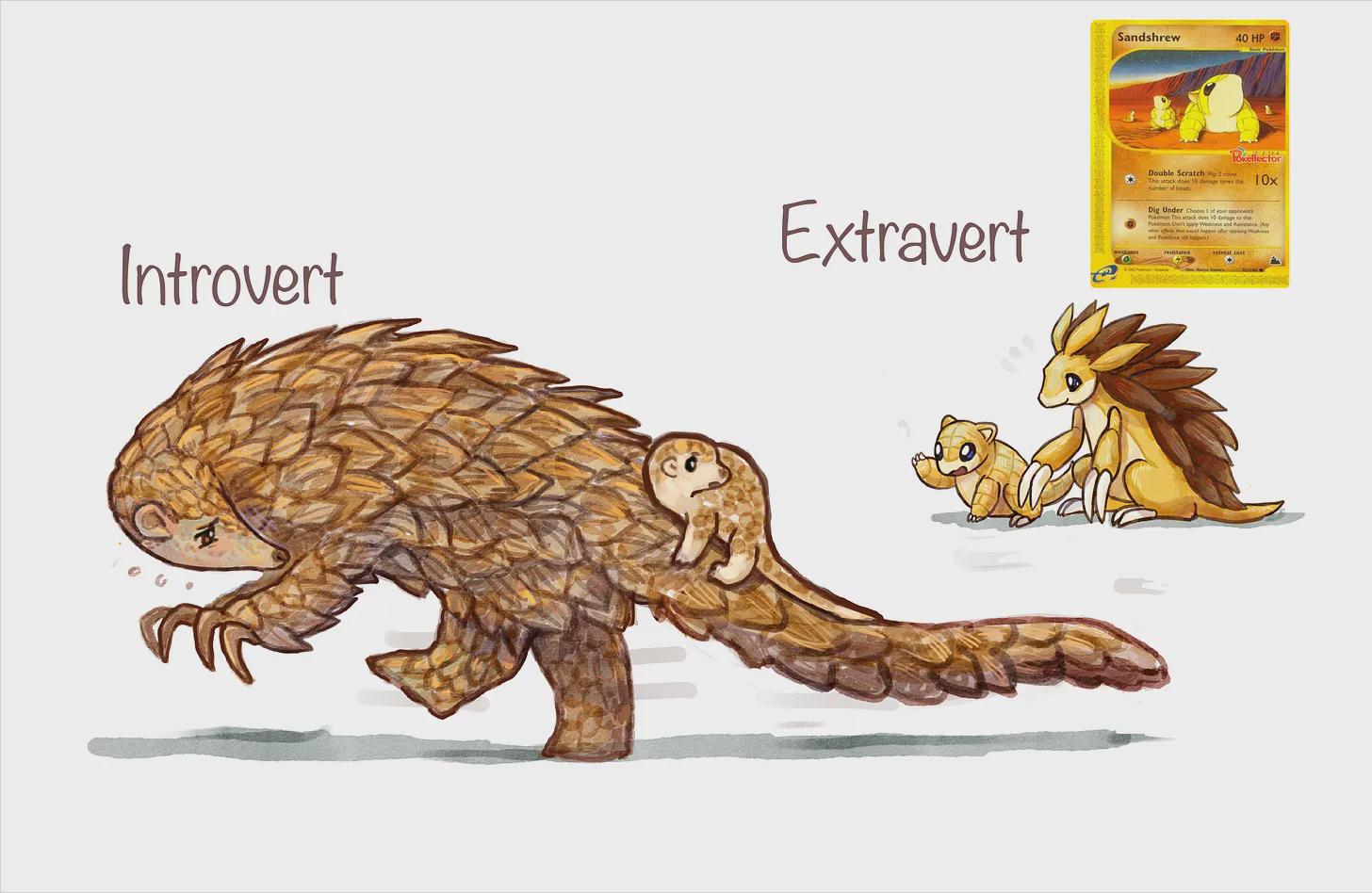
A 2025 paper on getting teenagers involved in pangolin conservation put a finger on something I’ve suspected for years: grim facts don’t reliably change behavior. For a lot of us, what helps more is agency—and starting from something we already care about. So for World Pangolin Day, I’m trying something simple: learn one genuinely cool thing, then make it easy to share.
And this feels like a good time to admit something: a big part of my first “loving animals” as a kid was Pokémon. I learned silhouettes, habitats, and how creatures fit into environments through character design long before I learned any biology. I still collect cards—because sometimes a card is basically a tiny science prompt.
Enter: Sandshrew and Sandslash. Sandslash’s Japanese name is “Sandpan” (サンドパン)—and that “pan” feels like a pretty clear pangolin wink. The “roll into a ball” thing is also real: when threatened, pangolins curl up tightly, protecting their soft undersides with armored scales. Sandshrew’s Defense Curl energy is weirdly on-model. (Even “pangolin” traces back to a Malay word meaning “one who rolls up.”).
The card I took out of my collection today shows several Sandshrew hanging out together at sunset. Great mood… but it does not really the depict pangolin biology. Pangolins are massive introverts. They are largely solitary and usually only cross paths to breed. The main “social unit” you’ll reliably see in the wild is a mother with her young. And the way they travel is amazing: ground-dwelling pangolins often walk on their two back legs, so the mother’s thick tail acts as a built-in transport seat. The baby literally hitches a ride on the base of her tail while she wanders around. If a predator shows up, the baby slips under her belly, and she rolls into a scaly vault around it. So if your feed today is full of basic “pangolin facts,” I want to zoom in on the less-clickbaity truth: their social life is mostly “don’t,” and their daily routine is basically burrow + night shift.
A 2025 GPS tracking study on released Chinese pangolins mapped that routine in detail: their activity starts in the early evening and is almost entirely locked between 10:00 PM and 4:00 AM, with big individual differences in home-range size. And here’s the part that still blows my mind: that “burrow life” isn’t just personal—it reshapes whole ecosystems. Another 2025 study found Chinese pangolins moving into burned forest sites and digging burrows that act like temperature-buffered microhabitats—“biodiversity magnets” that support other animals and help forests recover. But studying these cryptic animals to learn these things is incredibly difficult. Also in 2025, researchers showed that standard camera-trapping often fails—until you use Indigenous Adi ecological knowledge to identify the exact right burrowing microhabitats, which dramatically improves detection. And that brings it all back to why the doom and gloom approach fails.
If we want people to care about pangolins, we just need to meet them where they are. If you know a kid (or adult) who loves Pokémon and has a Sandshrew card, it’s a perfect doorway into the real animal. Tell them about the tail-hitch rides or the forest-healing burrows. Once a real species attaches to a creature they already love, it tends to stick—and pangolins might land a little differently the next time they show up on the timeline.
### Papers cited
-
Cao, M. C., & Le, T. M. D. (2025). _Motivation to pangolin conservation among Gen Z: applying the extended Theory of Planned Behavior._ **Journal of Environmental Engineering and Landscape Management**, 33(4), 356–367.
-
Huang, H., et al. (2025). _The Activity Rhythm and Home Range Characteristics of Released Chinese Pangolins (Manis pentadactyla)._ **Animals** (MDPI).
-
Sun, S., et al. (2025). _Chinese pangolins facilitate ecological restoration in burned forest sites by burrowing._**Global Ecology and Conservation**, 58, e03416.
-
Pilia, C., Datta, A., & Nijhawan, S. (2025). _Indigenous ecological knowledge improves camera-trap detection rates for the Chinese pangolin in Arunachal Pradesh, India._ **Oryx**.
by Anyonya21