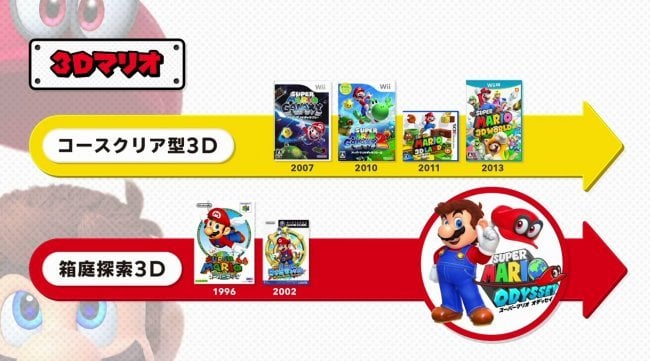
Upon the announcement of Super Mario Odyssey. Nintendo put out a [chart](https://www.gamereactor.es/media/93/_1979333.jpg) that categorizes the 3D Mario games. The Galaxy games and 3D Land/World are categorized as the traditional ones, while 64, Sunshine and Odyssey are categorized as the Sandbox ones. While dividing the games up makes sense, I’m not really sure how I feel about them lumping the Galaxy games with 3D Land and World just because they’re linear. Yes, Galaxy 1&2 are much more linear games than their predecessors, but they have a lot more in common with 64 and Sunshine than they do with any other 3D Mario games.
For one thing, Galaxy doesn’t put you on a time limit like the 3D games do, so you can go through the level at your own pace, much like 64 and Sunshine. Second, Galaxy 1&2 were the last 3D Mario games to follow the mission-based template of 64 and Sunshine, by collecting Power Stars. This format was completely scrapped with the 3D games, replacing it with the more classical get to the flagpole gameplay of the traditional 2D games. Finally, even though Galaxy is more linear than previous 3D Mario games, it was still very different form the boxy, isometric style of the 3DS and Wii U entries. Each galaxy still had different planets to visit on the side, as well as hidden stars. So even though they’re point A to B, they still give the player a bit of wiggle room.
So yeah, I disagree with how Nintendo categorizes the Galaxy games. Personally, I consider them a weird transitional period that sits right in the middle, rather than the black & white scenario Nintendo is painting it as.
by TheMisterManGuy
42 Comments
I really just don’t care. It’s their creation, I’m cool with their categories. If anything, I’m of the rare breed that wasn’t crazy about Galaxy, the main reason being that SINCE it isn’t a level-by-level game, having a bunch of linear “missions” within each level just made the game seem extremely limited in the level department.
And just for the record, I’m finding all of the genre labeling annoying these past few years. Videogames are starting to feel like some ridiculous technical breakdown of gameplay tropes, framerates, resolutions, limitations and cold, intangible numbers rather than attractions and experiences. I’m over it.
This is what I think the categories should be:
Mission Based (nonlinear elements but structured and each world changes depending on the mission): 64, Sunshine
Action Based (semi-linear, with a focus on setpieces and interactivity): Galaxy, Galaxy 2
Course Clear (level based, linearity with a focus on developing concepts to a crescendo per stage): 3D Land, 3D World
Sandbox (focus on exploration, collection, and environmental interactivity): Odyssey
Thats why im worried. I really like the mission based gameplay in sunshine and 64, but it seems you just explore and do things in a big map in odyssey, it seems to be focused on exploration like banjo kazooie more than a mario game thats mission based. Idk if ill like it as much. It looks amazing but i just hope it doesnt change the game too much. My thought is they got rid of the need to jump in and out of the world to complete objectives to save time, and make the gameplay more fluid, so honestly it could be a change for the better
The thing I think separates Galaxy away from the likes of Sunshine and 64 is that it does feel linear. Galaxy 1 to a lesser extent but 2 is literally on a line on the world map and I definitely felt a shift away from that exploration fun I had in Galaxy 1 in the hub world – which I feel is akin to the kind of fun I had running around Delfino Plaza.
The Galaxy games feel like you start the level and have to get to the finish while 64 and sunshine feel like you’ve been dropped in a world and you’ve got to figure out what the hells going on and sort the shit out, and much less of a race to the flagpole.
I’m probably doing a bad job of explaining it but it’s definitely in the feeling of the games for me
I don’t think so, honestly. You can only go after 1 specific star every time you enter a level- the game doesn’t give you a choice like 64 did (and in that aspect I think Sunshine too feels more linear than its predecessor) except for the hidden stars. However, unlike Sunshine, the levels are almost completely different every time you go through them. The only real non-linearity comes from the aforementioned fact that there’s one hidden star per galaxy and the fact that you can decide to skip some galaxies if you have enough stars. I definitely agree that it’s not necessarily as linear as 3D Land or 3D World, but I still think it’s a linear-enough experience to be compared to those games.
The Galaxy games are explicitly linear. They even explained why ten years ago in developer interviews.
The designers felt that a “problem” with 64 and Sunshine is that players got lost in the sandbox. The solution that they settled upon was partly based on an experiment with spherical worlds with micro-gravity that they had done back in the Gamecube days.
– Instead of a sandbox with eight degrees of exploration there is a linear sequence of spheres or platforms which are traversed from one to the next.
– Spheres were used as a shape because *players can’t get lost.* If you lose your bearings you simply have to run straight for long enough and you’ll end up where you started. Easy!
In the end the Galaxy through 3D World games have the player go in linear sequence towards a single goal instead of exploring a large map to find it. The important difference with 3D World is that they added a clock (superficial IMHO) and pulled the camera back so that there would be room for four players. However, from a map design standpoint 3D World shares a lot specifically with Galaxy 2.
This makes sense given that 3D World is a refinement of the ideas from Galaxy 2. Mark Brown’s terrific video on 3D World’s level design does a great job illustrating this: https://youtu.be/dBmIkEvEBtA
Either way, I’ve been saying for years that 3D World was the clear culmination and perfection of what they started with Galaxy. There is a clear distinction between those games and 64/Sunshine. Seeing the developers back up that claim was validating.
Cheers
[deleted]
Just FYI, you would say it’s *more* linear than the other games. “Linear” is not a comparative, like “hotter” or “colder”, it’s simply an adjective.
Oh jeez I thought you were calling Odyssey middle ground for a sec! But yeah, Galaxy is pretty unique, it’s not really sandbox or linear.
To be fair, sandbox gameplay wouldn’t work in Galaxy’s environment. But I do agree they’re a middle ground, and they lean more towards 64 and Sunshine’s side due to the idea of collecting Power Stars as well as Mario using health instead of power-up stages.
I’m just going to go with however Nintendo classifies their own games.
The Galaxy games are probably my all time favorite games and IMO the perfect amount of linearity for a Mario game.
I basically reject the idea of categorising 3D Mario games simply by their supposed linearity. There’s way more to a Mario game than just that. I feel it all stems from this false notion that linearity = bad and open = good. I have always found 64 and Sunshine to be a particularly bad fit together – I find those games to be pretty much nothing like each other outside of the basic Mario concept and the controls. I categorise them based on what emotions these games evoke to me, giving roughly the following list.
**Defining/Revolutionary/Epic**
* Super Mario 64
* Super Mario Galaxy
**Fast-paced fun**
* Super Mario Galaxy 2
* Super Mario 3D World
* Super Mario 3D Land
**Sunshine**
* Super Mario Sunshine (for better and for worse this game feels strongly like the odd one out in the series to me)
Galaxy and Galaxy 2 lie right near the borders of their respective categories so while I’ve placed them in different categories they are very close to each other as well as the games in their respective categories.
Odyssey looks like it is strongly trying to be in the top category but I’ll have to play it to see.
[deleted]
I enjoy all of them. What I don’t enjoy is fans of 64 shitting on the other games for being too linear.
Definitely middle ground. Galaxy 2 could maybe be put in with 3D Land and World, but even then it’s still pushing it imo.
I agree with you on a lot of points. IMO, though, it’s more of a progression from sandbox to linear with 64 the most open, Sunshine a little more linear (have to go through the worlds in order of missions, unlike 64 where you could mix and match, Galaxy is a decent middle ground- hub world, some open worlds, but largely linear based levels as well, Galaxy 2 is further linear with arguably no hub world, and what appear to be a map-based progression (I’ve never actually played), and 3D world being the final linear game, which is slightly less linear than the other 2D Mario’s. Honestly, I don’t think nintendo should lump the 2D games in with the 3D. They’re too different imo.
[deleted]
I would actually put Mario Galaxy 1 with 64 and Sunshine, and Mario Galaxy 2 with the linear Marios.
Galaxy, like 64 and Sunshine, expanded the world and introduced new staples in the franchise. 64 introduced the iconic Peach’s castle, Sunshine introduced Bowser Jr, and Galaxy introduced Rosalina.
While Pauline isn’t technically a new character, her role in Odyssey may result in her being a mainstay in the series from now on.
They are a middle ground, possibly the perfect entity I might add, but the entire point of this categorisation wasn’t that the Galaxy games and the 3D games are heavily linked, they literally just wanted to show that they are going back to the Sandbox roots of 3D Mario as opposed to the linearity that has been around recently. It was just to demonstrate that Odyssey is sandbox, you’re kinda overthinking it.
Yeah, it’s definitely in between. 64 and Sunshine were about exploration, and the others were about point A to point B. I think one of the greatest strengths of the Galaxy series is that it had bits of both. It had levels that were 64/Sunshine-style (including one that’s literally a clone of a 64 level), but it also had “obstacle course” levels. It’s definitely a middle path.
I’ll agree to that. Sure, most of the levels were “get from point A to B” But it felt no different than playing 64 or Sunshine. Mario still controlled the same, he only lacked his belly slide! The levels just weren’t designed as a sandbox, point being that the games themselves take place in space.
Not all the planetoids are small, useless platforms to find a launch star on! Some are large and resemble the wide open explorable levels from previous games. They might not hide many secrets and you can’t find a star out of sequence not unlike Sunshine, but it’s still something pretty to admire!
I find that Super Mario Sunshine probably should’t be grouped with SM64, and instead should be in a 3rd category with the two Galaxy titles; here’s why.
Super Mario 64 did a few things that truly made the game feel open.
* You could tackle levels out of “order”
* You could finish the game with ANY set of 70 of the 120 stars
* With few restrictions you could collect any star in any version of a level. Obviously there are exceptions to the rules such as boss fights or races but most stars are just sitting around waiting to be collected.
These three things meant that an experienced player could realistically get the required number of stars all without having collected a single one from any of the upstairs levels.
This level of freedom almost feels like a carry over from Super Mario World where a knowledgeable player can beat the game in just a handful of levels.
When Super Mario Sunshine came out it too had 120 Shine Sprites but it did a number of things differently.
* You can’t unlock levels out of order
* You can’t select which Shines are important. You must beat mission seven in every main level in order to unlock Corona Mountain. Doing so requires tackling each shine prior to mission seven rendering the others all useless unless you’re going for a full completion of the game.
* You can’t tackle missions out of order with very few exceptions (special areas).
Each level appears to try to tell a story over its various chapters/missions but ultimately what may be nice for the continuity of the level makes the game feel much more restricted. In spite of these progression changes all levels maintained their open structure but while you were free to explore, very little of value could come for it. Again, since progression is locked behind specific missions, collecting blue coins or 100 coin Shines may feel good for the player but won’t change how they reach the end of the game. If you don’t like a specific mission prior to mission 7, that’s too bad.
When Galaxy 1 came out there was almost a return to form in some regards in terms of freedom for the player.
* Not all levels are mandatory and can be unlocked as the player collects stars
* Levels are unlocked in clusters similar to Mario 64
* Some missions provide alternate stars via hungry luma encouraging exploration
Yes, much like Sunshine you can’t collect stars out of order within a level. That said the player CAN find alternative stars in the form of hungry lumas or comets. This encourages the player to explore AND rewards them for leaving no stone unturned. In some ways Galaxy 1 feels like an attempt to find a common ground between the real freedom of Super Mario 64 and the false freedom of Sunshine.
Galaxy 2 on the other hand, didn’t make any attempts at hiding its true colours. The map is linear, the levels are linear, and unlike Galaxy 1 where a big galaxy would have 3 main missions plus comet missions (usually for a total of 6); the Galaxy 2 major galaxies would have 2 main missions, 1 comet mission, and only after you beat the game would 3 additional green star missions unlock.
As a result of the reduction of stars per galaxy and the linear level select Galaxy 2 forces players to play specific levels and specific stars to unlock later levels. The choice both on the map screen and within the levels as to which star to collect is decreased and thus Galaxy 2 is a much more linear game than its predecessor.
In many ways the level of freedom in these 4 titles should really be:
Most: 64 -> Galaxy 1 -> Galaxy 2 -> Sunshine :Least
but because Super Mario Sunshine *looks* like a successor to 64 we have this perceived notion of freedom.
Happy to have discussion on this regardless of whether you agree or disagree.
Edit: Realized I didn’t end up returning to my initial thesis statement. The level of freedom of progression given to the player should be a more important factor in describing sandbox games than the ability to wander a level aimlessly. That in mind so far on Super Mario 64 and soon to be Super Mario Odyssey reflect this idea, so Sunshine should be in a category with Galaxy 1 and 2.
Agreed.
I’ve seen people drawing a stark contrast between Galaxy and 64 a lot but… they aren’t really that different. Galaxy has more focused level design, but the execution is pretty similar. It often has a more a linear approach to a goal, but there will still be levels with room for you to go off on a rabbit trail and end up doing something else.
Galaxy is generally more linear, which is what that list communicated, but I think saying it’s somewhere in the middle is a much more fair analysis.
I always thought of Galaxy, Sunshine, and SM64 as having essentially the same gameplay, but with different features, until I heard people talk about how Galaxy was so linear. I guess I see the point, but I got the same “feel” from all of those games.
Super Mario 3D World was great too, but I definitely saw the difference very clearly; it seems to me like a traditional 2D Mario, but in 3D. On the other hand, the levels are way more creative and various, each with their own special features, making SM3DW feel somewhat like the other 3D games. I guess the 2D platformers are kind of on the open -> linear spectrum as well.
I would say it’s middle ground but closer to the more linear Mario’s. I don’t think they felt much like 64 or sunshine
If you want 2 categories though, Galaxy belongs with 3d World. There is no 3rd middle-ground category.
It’s not just the Galaxy games. Looking at how the 3D Mario games evolved from 64 to Sunshine to Galaxy 1 to Galaxy 2 to 3D Land and World, you can see a very clear trajectory with every entry from 64’s open freedom to 3D World’s linear levels.
**Mario 64** – Extremely open. A huge castle hub to explore, and outside of a handful of specific missions, you can complete the stars of each level in any order, and while the goal is always collecting a star, getting that star or making it appear can be done in many different ways.
**Mario Sunshine** – A smaller hub, levels are still open to explore but almost always change based on the mission and shines cannot be collected out of order, there were a lot of “secret” levels that were purely about platforming from beginning to end, but there’s still a lot of variety in how you get the shines, be it through platforming, exploring, collecting, etc.
**Mario Galaxy** – The hub is even smaller, levels are mostly pretty linear (though there are still a few that are somewhat open, like Honeyhive Galaxy), the different missions in a level completely change the level’s layout but not so much that it’s unrecognizable (i.e., you’ll visit some more noteworthy landmarks in multiple missions), and while there’s a greater emphasis on platforming than the previous two games, the missions still have a fair amount of variety with things like silver stars, mini-games, and secret alternate paths.
**Mario Galaxy 2** – The “hub” is just a single planetoid and isn’t really a hub anymore since you now select levels from a map screen, levels are now almost entirely linear, the different missions in a level are now pretty much completely separate levels only tied together by a similar theme, and while there’s the occasional silver star mission or something, the focus for the most part is now purely on platforming. However, a lot of the surface level stuff still feels more like the previous 3D Mario games, like how Mario has HP, power-ups are required to beat many levels and can’t be carried to other levels, Mario has fully analog control, and the camera can still be controlled in many places.
**Mario 3D Land/World** – There’s no hub, just a map screen, levels are all entirely linear with the exception of a few ghost houses, and there’s not much variety in goals beyond going forward until you reach the flag pole. Beyond structure, many elements were brought back to the 2D style of games. Mario’s health is determined by power-ups and not HP, the power-ups are now usually more like optional bonuses as opposed to integral elements of the level design, the camera can’t really be controlled, and the time limit is back.
So I definitely agree that it’s not a black and white thing. Instead of being two categories, it’s more like a continuum, with an exploration focus on one end and a platforming focus on the other end. Mario 64 would be far to the exploration side, 3D World and Land would be at basically the end of the platforming side, and the rest of the games in the series would basically line up in order. From what we’ve seen of Odyssey, I think it’d fall on the exploration side, but much closer to the center than 64 and Sunshine.
And as a side note, I think basically every 3D platformer can be placed somewhere on this continuum. Banjo far towards the exploration side, Crash far towards the platforming side, Jak 1 close to the middle.
I could understand how they classified Galaxy 2, as Galaxy 2’s levels are almost entirely linear, and you rarely visit the same spot twice.
But Galaxy 1 is structurally from the same backbone as Sunshine and 64. There are several levels that put you in wide open spaces you have to look around and that you revisit, and most levels have at least one common “hub” area. The Comet Observatory was a solid hub world in itself.
I’m very hyped for Odyssey, but I’m really hating how Galaxy is getting dismissed so easily. It’s easily one of the greatest games I’ve played in my life.
Agree, Nintendo is absolutely wrong on this. Galaxy is honestly closer to 64/Sunshine than the NSMBised 3D World/Land.
Super Mario Galaxy 1 & 2 are the #2 and #1 best Mario games.
Yeah, I’ve thought for a long time that the Galaxy games – Galaxy 2 especially – were the intersection between the amazing 64/sunshine-style 3D Mario games and the linear 2D Mario games with a Z-axis.
Please don’t be like sunshine. Please don’t be like sunshine. PLEASE DONT BE LIKE SUNSHINE!!!!
It is closer to the middle then galaxy 2 and labd/world.
But it is definitly still on the linear side of the divide
I think part of what it comes down to is the feel of the game. While galaxy and sunshine are more linear than 64, they still have a consistent theme. If a sandbox game is mostly about free exploration, while galaxy lacks some sandbox elements there’s still the feeling of exploration. Multiple playthroughs of a galaxy shows different areas, different galaxy’s relate and all of them have a strong theme.
Compare this to Mario 3d land/world where there is no thematic exploring whatsoever, more just looking for secrets similar to 2d Mario platformers. The levels are different coloured cuboids arranged without much consistency and the map screen doesn’t have thematic consistency either, focusing completely on getting to the game play.
I don’t know where you got the
> Galaxy games and 3D Land/World are categorized as the traditional ones, while 64, Sunshine and Odyssey are categorized as the Sandbox ones
from, but コースクリア型3D means “course clear type 3d” and 箱庭探索3D means (like you said) “sandbox search 3d” and this makes perfect sense. Galaxy has courses you clear, yes you collect power stars, but the game is built on clearing courses.
I completely agree with [Nintendo’s official classification](https://www.mariowiki.com/File:3D_Mario_Infograph.jpg) of having the Galaxy games in the same category as 3D Land/World. The Galaxy games may not be as linear as 3D Land/World, but they’re still pretty linear and not really as open as 64/Sunshine. The Galaxy games feel a lot more easliy accessible than their older counterparts. However, I can see what OP means. With each new 3D Mario title, you can see how the series has slowly progressed into what it is today. The Galaxy games may be linear, but they still definitely share things in common with 64 and Sunshine: Mario’s health meter, the different power up system than the 2D games, as well as the overall large atmosphere and scale of those games.
Super Mario Galaxy 1 and 2 were incredible. I would rather play them than super mario 64
This is the reason I was truly wary of Galaxy at first, but I ended up loving it anyways.
3D World kind of did the same thing but with the 2D vs 3D formula being mixed and creating something in the middle.
As a big Mario fan, no game has disappointed me though.
Galaxy features some larger and more open environments like the honeyhive kingdom.
I think my main quibble with SMG1 (I haven’t gotten around to 2), is that while the worlds aren’t 100% linear, none of them feel like they make any sense. They don’t have any “place” in the world. They’re just floating rocks in varying flavors and they’re all so tiny. In Sunshine every stage feels like it belongs in the broader scope of the island. I don’t feel like I’m exploring when a place feels “fake”. Even large stretches of 3D Land and World make levels feel like they belong. This isn’t to say SMG is a bad game, it’s a good game, it’s just why it’ll never be my favorite.
The Galaxy games honestly aren’t that different from SM64/SMS/SMO. Same objectives, same controls, same camera styles. The stages are a bit linear I guess but so are they in other Mario games. I mean sure you can climb to the top of Bob-Omb Battlefield and go back to the bottom if you want to but there’s no reason to. In Galaxy in some stages I guess you can’t go back?