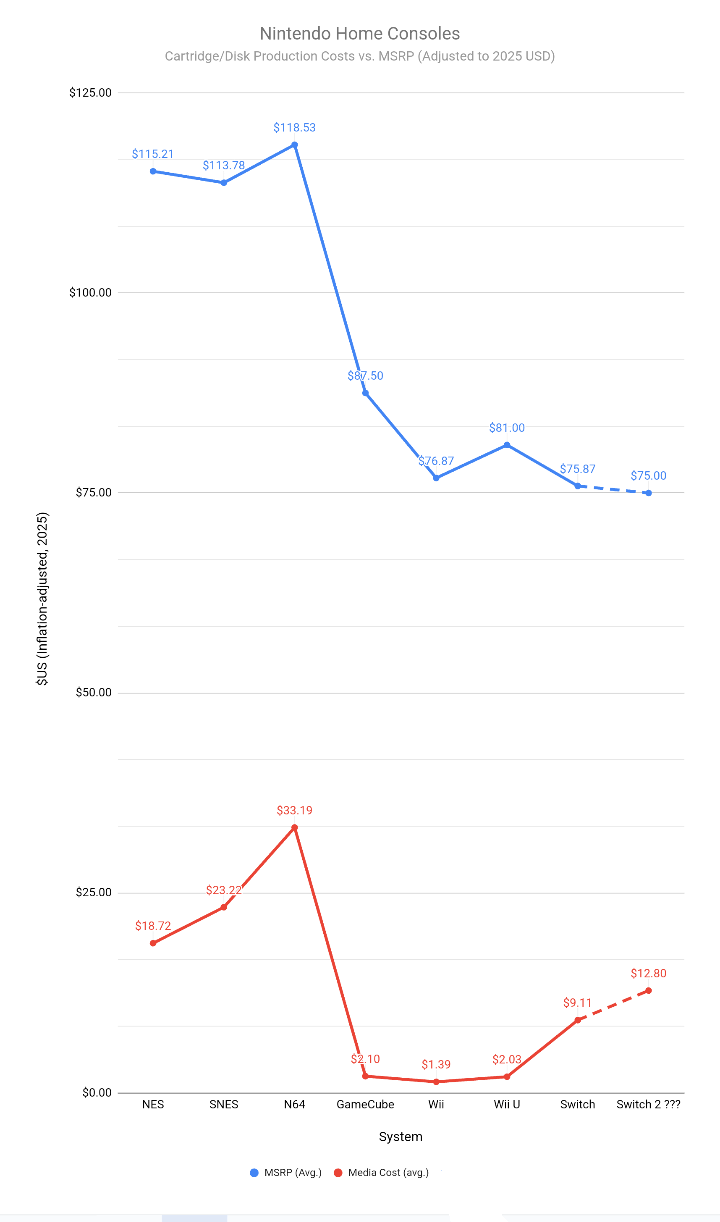
With the Switch 2 announcement and people debating whether $70 games are justified, I thought it'd be interesting to look back and compare how game prices and media costs have evolved over Nintendo’s history.
This graph shows the inflation-adjusted MSRP of new games vs. the cost to manufacture their cartridges/discs, for each Nintendo home console — from the NES (1985) through the projected Switch 2 (2025). All prices are in 2025 USD, based on U.S. launch years and U.S. inflation.
⚠️ Caveats and context:
-
These are U.S. prices only, adjusted for inflation from the North American release year of each console.
-
Both MSRP and media costs vary — games came on different sizes of cartridges and discs, and game prices weren't always fixed (eg. Switch cartridges can range from ~$2 for a 1 GB card to ~$15 for a 32 GB one.) I used the geometric means for both because I don't know how to make a line graph showing ranges.
-The Switch 2 media cost is entirely speculative — I’m assuming it’ll be more expensive than current Switch carts because:
-
Bigger games (up to 64 GB or more).
-
Higher-speed data transfer (possibly using faster NAND). But again, this is just my estimate, not insider info.
What the graph shows:
Game media was really expensive to produce in the cartridge era — N64 especially, with adjusted costs over $30 per cart.
Nintendo cut those costs drastically with the move to optical discs starting with the GameCube. The Switch brought some cost back with proprietary game cards, but still nowhere near cartridge-era levels.
MSRP, meanwhile, has stayed remarkably consistent in real terms, with modern games arguably offering more value for the money.
Happy to share the data or make a handheld version if folks are curious!
Edit: Not trying to make a case or argue for anything, just presenting data.
by C0smicM0nkey
30 Comments
Actual data instead of reactionary knee-jerking. Great post. I hope everyone in this subreddit reads this and adjusts their world view (spoiler: they won’t).
But modern games have a lot of extra costs that don’t show up in base pricing:
– DLC
– Season passes
– Online subscription
– Deluxe editions
– Peripherals
– etc.
While the purchase price might not have drastically increased across the last few years, the price of gaming as a whole has gone drastically up.
Should also add data for cost of living, average wage increase, buying power, and stuff like that during the same time period for a better understanding on prices over time.
Just pure dollar value doesn’t mean anything, with or without inflation. Economics don’t exist in a vacuum.
I’m a bit confused on the graph. Switch games look like they are at $75, but they were lower. Where did that price come from?
Edit: Is that just due to inflation? So the fact games have been the same in 2017 to 2024 means that 2017 increases the price while 2024 games decrease it?
Edit 2: Damn, just went through an inflation calculator and wow. $60 in 2017 is $78 in 2025.
Was inflation since 2017 that much?
Edit 3: Okay, I don’t actually need any more answers to this. Despite how I phrased and what I wrote, I *am* actually fully aware that inflation was nuts in the last few years. It was mostly a product of how I was interperting the graph initially, as well living through each price jump happening in increments and not really looking back at the total jumps. Plus, I’m tired.
I have my answer, thank you.
N64 prices were insane back in the day. A lot of Games started at 70 dollars. That’s 140 dollars in today’s money.
My biggest issue is how Nintendo would rather drown a cat than lower the price of their first party games. Lets use past examples to assume the next mainline Zelda is going to be $80/$90 at launch. In five years it’s still going to be that price with skimpy sales on Black Friday. And if it has DLC you are not going to see a GOTY edition for that game, if will almost always be full price plus DLC. Hell BotW, an almost 10 year old game, is going to be $70 on Switch 2.
N64 was an incredibly advanced and _expensive_ system. My parents were amazing.
So the pricing matches the inflation. If only the salaries did as well…
Tbf I feel like Nintendo has the strategy of increasing the pricing of Switch 2 games so they could keep the pricing of Switch 1 games the same and keep selling them prospect of them being still playable on Switch 2. Switch 1 might as well still stick around as the budget options for potential buyers.
But this is reminds me of Playstation 3 and we all know how succesful that was…
As someone who was gaming when the NES first came out, I can say that for many families, the cost of the system and games made them completely out of reach. It’s one of the reasons the console wars was really a thing. Most folks could only afford Sega or Nintendo.
I really think the perspective needs to change on this. Pointing out that games used to cost more doesn’t discount the fact that $80 is a lot of money for a lot of people now. Both of those things can be true.
Nintendo doesn’t exist in a bubble. There are alternatives and comparisons available. They chose that price point and decided to push the bounds of what people would pay. If they released it 70, then I think most would have been disappointed but not surprised. Instead here we are talking about game prices instead of the actual system.
It’s hard for me to defend a billion dollar company. They’d still money hand over fist if they sold their games for $59.99.
I’m not doubting the data, but the fact that *technically* games were cheaper in the past doesn’t mean I have a proportionally equal amount of disposable income.
60$ games are already expensive enough for me to buy one at full price once every few years. 80$ will just make me not even consider buying new games, I just hope the used games market will be as affordable as Switch 1 is.
All this analysis about prices and inflation seems pretty irrelevant if there is a price point in which the majority of consumers no longer see it as worth the cost. If games kept pace with inflation, I’d have stopped gaming a while ago.
I’m sure I’ll get downvoted in this subreddit, but I’m not sure why people are defending this. I know that inflation is obviously a thing and it’s pretty miraculous that games haven’t really increased much over the last decade, but this is a huge jump.
Sony and Microsoft both increased the prices of their games to $70 in the last generation. $70 has become the new norm only in the last couple of years.
Nintendo is leap frogging past them. Some of their games have been $70 and some have remained at $60, with a handful of games cheaper.
Not to mention the fact that Nintendo rarely puts their first party stuff on sale.. if ever. Microsoft and Sony have sales all of the time and if you wait a few months after a first party release you can get it for significantly less. Not to mention Game Pass has all Xbox first party games day 1.
I think one of the main factors is the sudden jump. Increasing prices 33% from the standard is a huge jump, especially when the industry standard is even lower. The largest jump in game prices for a Nintendo console is $15 with the NES to the SNES, which many Redditors weren’t around for. Every other generation of Nintendo has had either the same price or a less than $10 increase. This huge jump is also understandable when for those who make minimum wage, their pay hasn’t increased since 2009. It’s also about expectation. Everyone expected Switch games to be $70, so a $10 increase on digital games and $20 on physical seems unreasonable for many. It’s not the fact that the prices are going up, it’s also setting a bad precedent for other companies.
It astounds me the people who disingenuously try to argue that physical media is chapter to produce now, or that that is the only cost going in to games.
Game *development* has exponentially gone up. More people working longer with more expensive tools to make a game. It’s not the cost of the cards, it’s the backend cost of development that is driving up costs.
Trying to comment how producing the physical thing is cheaper now is disingenuous at best and misinformation at worst.
When I was in college in 1996-97 I was an early owner of the N64, getting one for Christmas.
Not too long after I brought it back to my dorm after the holidays a friend of mine called me, he was at the mall and spotted a copy of Mario Kart 64 which had just come out, and asked if he should pick up a copy for me. I said yes.
I didn’t ask how much it cost, and was a bit perturbed to find the price was just over $80. In 1996.
So I do find all of this hand wringing over Switch 2 game prices a bit funny. Young people today don’t know how much better deals are now for games than basically any other time in history. I don’t *like* paying more money for games, but the value proposition is just fine in historical context.
My pet theory is that most people were just too young in the 90’s/00’s for the $60 price tag to mean much to them, and with the sticker prices finally shifting after 30 years, people are revisiting the value proposition for the first time since they were children.
Furthermore, while games are offering orders of magnitude more & deeper content than 30 years ago, so the value proposition *should* be way higher, most of these people who are now adults simply have less free time to enjoy games.
Or idk maybe that’s just me. But $60 felt like a lot of money in 1999, I’m pretty sure!
Edit: I’ve been corrected that $50 was the base retail price for AAA games around 1999, $60 was established with the 7th console generation in the mid-00’s. Larger point stands.
only on nintendo sub would you see people justifying high prices for the company, and praise them for having gameshare video that is 10 frames per second.
Where are the dlcs and upgrades and amiboo and season passes mapped on this graph
And here I thought the switch 2 would break Nintendos curse of having 1 great system and then a bad system, in terms of sales at least.
N64 good.
Game cube not good.
Wii good.
Wii u not good.
Switch good.
Switch 2… with these game prices im guessing not good
You might not be trying to argue, but this is still an argument. And, respectfully, it’s an incorrect one.
Nintendo’s new price point isn’t the result of inflation. It’s a contributor to inflation. They’re not raising prices because they have to, they’re doing it because they want to. They’re testing how much they can pull from their fanbase while hiding behind the idea that “game prices have been stagnant for 20 years.”
But let’s be honest. Storage costs have gone down. Online distribution is everywhere and cheaper than ever. Hosting a master file for download costs next to nothing at Nintendo’s scale. Developers aren’t suddenly getting $30 more per copy. There’s no external force pushing this. This isn’t a response to inflation, it’s inflation in action.
And yeah, it might look like a one-time jump now, but it sets a precedent. Just like when games went from $50 to $60. Just like when they started charging for online. Just like microtransactions. In ten years, we’ll probably be saying, “Wow, $90 was cheap compared to GTA 7 charging $200.” That escalation doesn’t just happen, companies like Nintendo create it by making price hikes feel normal.
They don’t need to do this. They’re already massively profitable. They just want more, and this is how they go about getting it. Nintendo could go back to $50 games and still make a fortune. But they won’t, because this isn’t about sustainability, it’s about maximizing return.
I know you’re not trying to defend them, and I do appreciate the data. But this exact framing will absolutely be used to justify their decisions, and it needs to be questioned.
Do another graph with Nintendo’s profit during those years.
Even if games and consoles have grown cheaper in the long term when adjusted for inflation, the reality is that housing, food, health care, and wages have not. Over time, the average person’s capacity to afford luxuries like games and consoles has decreased massively. This isn’t necessarily Nintendo’s problem, but it explains the escalating frustration of fans in response to pretty blatant anti-consumer practices.
If we give them the benefit of the doubt and suppose that Nintendo is just responding to an unstable world economy, they should realize that their consumers will do the same. If we suppose that requiring consumers to pay significantly more for games that are already increasingly unaffordable for many is the only economically feasible move and not even partly a shameless money grab, you’d think that Nintendo would try just a little harder to not burn through all of their remaining goodwill by nickel-and-diming already hesitant customers. Smugly presenting a paid tech demo, a paid chat system, paid upgrading of existing games just for FPS/load time improvements – all of which are free features for many other systems existing in the same economic landscape – communicates to customers that these prices aren’t arising out of necessity, but rather out of the corporate greed Nintendo is known for.
These practices are a bad look and they set a terrible precedent.
Ok now do wages and purchasing power. They haven’t risen with inflation.
People who think $80 now is going to feel like $60 in 2017 either don’t understand how economics work or are lying to themselves.
I am not really interest in the price range. It’s a bit steep for me, while I really enjoy gaming, it’s not something I need to be uptodate with the latest things. I’m just gonna enjoy my switch lite for a while longer, and maybe finally play Elden Ring for the first time 3 years from now.
2017 presentation – price revealed in first 5 mins. Point of pride by Nintendo about how affordable it is
2925 presentation – completely omitted any and all prices. Users had to piece together info for themselves after. Nintendo told media at hand-on they can’t ask questions on prices.
Ask yourself why that is.
I make pretty decent money and I still almost never buy games at full price, it just seems it’s not worth it with so many games constantly discounted from a few years ago
Why are people trying to act like how expensive games used to be should be normal/standard. The goal should be to offer entertainment at a reasonably cheap price. There’s a reason why CDs, DVDs, books and games have been cheap historically. When you increase prices you’re effectively fucking your dedicated fanbase and alienating others who might’ve been interested. This is a bad situation, regardless of how people try to spin it.
Here’s how I see it: Video games are a luxury good. Especially when you compare them to other forms of media and entertainment. Inflation is an issue, but wage stagnation and the price of essential goods and services like utilities, shelter and food increasing, a larger portion of the population will have trouble purchasing luxury goods.
If Nintendo is ok with having less sales and more revenue then that’s a decision made by someone or a team that has far more experience than I do. But as a consumer, it just means that I’m willing to wait for either a sale or a special edition and never buying a Switch game at launch despite the FOMO. Might not work for everyone but like most folks I have hundreds of hours of backlog to catch up on alongside the black hole free to play games I dive into regularly.
My wallet also has the same drop.
And I have a job only 5 years ago.