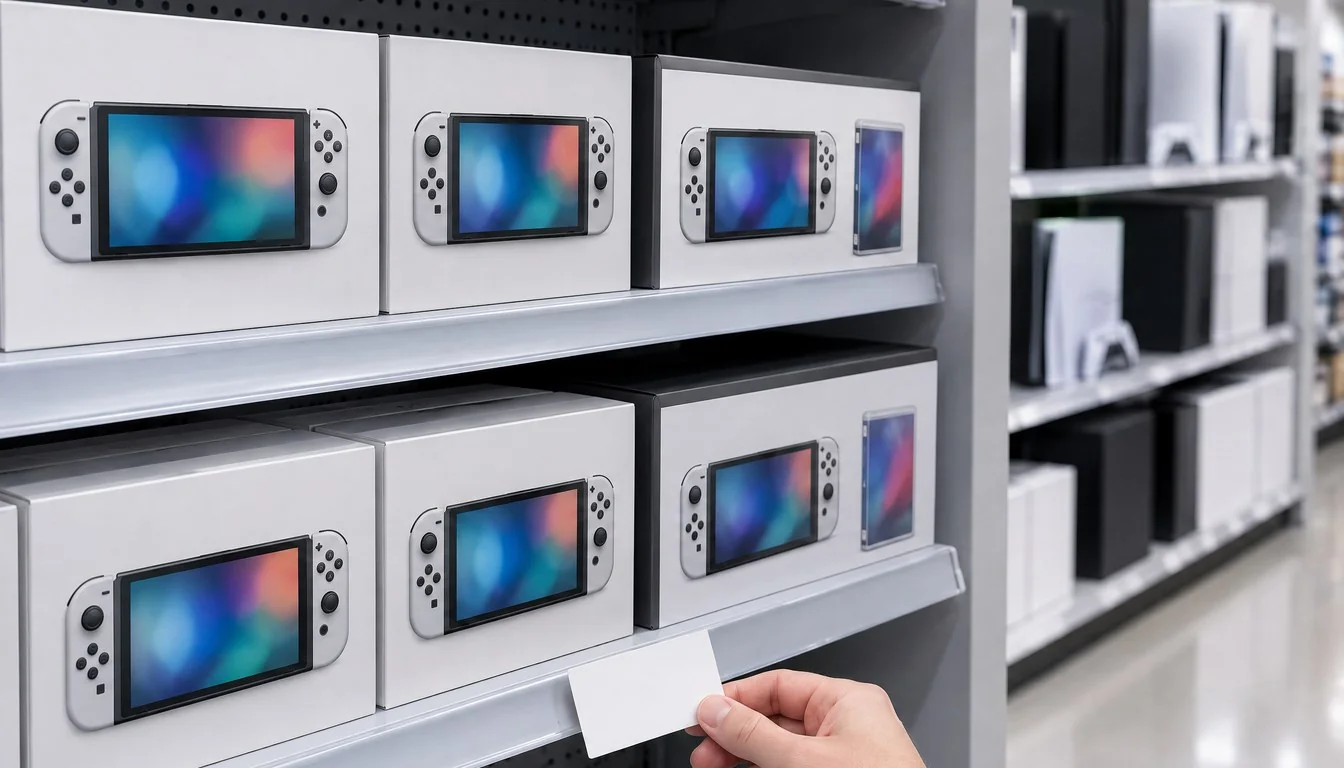
Nintendo raised the US price of the Switch 2 by $50, yet American buyers are paying barely more per console than they did a year ago. According to GamesRadar+, which cited Circana analyst Mat Piscatella, the average amount paid for Nintendo hardware in September 2026 rose from $486 to $498, a gain of about 2%. The headline of that report put the mood bluntly: the Switch 2 price hike hasn’t pushed consumer spending up.
What Circana’s September Data Shows About the Switch 2 Price HikeThe $50 Increase: Dates, Regions and Nintendo’s Stated ReasonsWhy the Average Price Rose Only 2%The Hidden Price Increase Inside the Bundle SwapWhat Buyers Actually PaySony and Microsoft Took the Price Hit Nintendo DodgedUnits Tell the Other Half of the StoryAugust 2026: The Weakest August Since 2013Historical Context: From Record Launch to Price FatigueMemory Costs and the AI Squeeze Behind the PricingWhat Analysts Are SayingCompetitive Comparison: Three Strategies for One Memory ShortageMarket Impact for Retailers, Publishers and Accessory MakersFive Predictions for the Holiday QuarterWhat This Means If You’re Buying a Switch 2 NowFrequently Asked QuestionsHow much did the Switch 2 price go up in the US?Are US consumers really spending more on the Switch 2?Why did the average price rise so little?How do PS5 and Xbox prices compare?Which console sold best in the US in September 2026?Why are console prices rising at all?Will Nintendo raise the price again?RelatedRelated Coverage
The base console moved from $449.99 to $499.99 on September 1, as TechTimes reported on launch day of the new price. Sticker shock should have lifted the average ticket by roughly 11%. It didn’t, and the reason says a lot about how Nintendo manages a hardware cycle in the middle of a global memory-chip squeeze.
Industry insights, the latest tech news, and special interviews, all in the Tech Insider Newsletter.
One email a week. No spam, unsubscribe anytime.
This analysis walks through the Circana numbers, the bundle shuffle that explains them, how Sony and Microsoft fared by contrast, and what it means for the holiday quarter. If you tracked the earlier pricing moves, our look at the Switch 2 digital versus physical pricing gap sets up the backdrop.
Google · Preferred Sources
Don’t miss new tech stories on Google
Add Tech Insider once in the Google app and our stories appear in your news suggestions.
What Circana’s September Data Shows About the Switch 2 Price Hike
GamesRadar+ pulled four numbers out of Circana’s September 2026 US report. First, the average price paid for Nintendo hardware climbed 2%, from $486 to $498. Second, US Switch 2 unit sales fell 14% year over year. Third, total US video-game hardware units dropped 3%. Fourth, the PS5 led the market in both units and dollars for the month, with the Switch 2 in second place.
Read together, those figures describe a market where the $50 increase got absorbed instead of passed along. Buyers who bought a Switch 2 in September paid $498 on average against a $499.99 list price. That’s a $1.99 gap, which suggests very little discounting at retail and very little spending above the sticker price on the console itself.
You may like
VGChartz and Pure Xbox both covered the same Circana release, and both framed the month as a year-over-year decline for Nintendo and Xbox hardware. That framing matters because the comparison month, September 2025, sat just three months after the record-setting June 2025 Switch 2 launch. Comparables were tough before any price change entered the picture.
The $50 Increase: Dates, Regions and Nintendo’s Stated Reasons
Nintendo announced the new pricing on May 8, 2026, alongside its full-year results. CNBC’s coverage of the announcement noted that the company expects console sales to decline in the coming fiscal year. Quartz added detail on the numbers, reporting a projected revenue of 2.05 trillion yen for the fiscal year ending March 2027, which is 11.4% below the prior year and well under the analyst consensus of 2.46 trillion yen. Quartz also reported that Nintendo expects a hit of roughly 100 billion yen from memory prices and tariffs.
The increase didn’t land on one date or one market. Japan moved first, with the yen price rising by 10,000 to 59,980 yen from May 25. The US followed on September 1. Nintendo pointed to changes in market conditions and the global business outlook, and said it expects those conditions to persist over the medium to long term. We covered the staggered rollout in our piece on the Switch 2 price hikes in Japan, Canada and Europe.
RegionOld priceNew priceEffectiveUnited States$449.99$499.99Sept. 1, 2026Japan49,980 yen59,980 yenMay 25, 2026Canada$629.99$679.99Per Quartz reportEurope (My Nintendo Store)€469.99€499.99Per Quartz report
Source: Quartz and TechTimes reporting on Nintendo’s May 8 announcement. The old Japan price is derived from the reported 10,000-yen increase.
Why the Average Price Rose Only 2%
The math doesn’t add up unless the mix of products changed. A $50 list-price increase on a $449.99 console is an 11.1% jump. For the average to rise just 2%, the September 2025 average of $486 must have already included a large share of higher-priced SKUs, which is exactly what a bundle-heavy launch period produces.
Piscatella told GamesRadar+ that a shift away from the Mario Kart World bundle toward the standalone console explains much of the gap. According to that report, the bundle had sold for $499. The new standalone system costs $499.99. A buyer who would have paid $499 for a console with a game now pays about the same for a console alone.
The Hidden Price Increase Inside the Bundle Swap
From the buyer’s side, the effective hike is the value of the game that’s no longer in the box. From Nintendo’s side, the company keeps the headline number low in dollar-weighted reporting, because Circana measures what shoppers actually pay. A mix shift from $499 bundles to $499.99 standalone units barely moves the average, even though the price per unit of content went up.
That’s the move Piscatella praised. Pricing an unbundled console at nearly the old bundle price lets Nintendo recover margin without the average transaction price spiking in the data that retailers, investors and journalists watch.
What Buyers Actually Pay
The $498 figure sits $1.99 below list. That gap points to little discounting at retail. Stores had little reason to cut a console that Circana ranks as the second-best seller in the US, behind a PS5 that is itself getting pricier.
Sony and Microsoft Took the Price Hit Nintendo Dodged
The same Circana release shows what a full pass-through looks like. GamesRadar+ reported that the average price paid for a PS5 rose 17%, from $551 to $646. The average Xbox price paid jumped 33%, from $497 to $663. Both platforms now sell at far higher average prices than a year ago, and Pure Xbox reported that Xbox hardware sales fell year over year as well.
PlatformSept. 2025 avg. price paidSept. 2026 avg. price paidChangeNintendo Switch 2$486$498+2%PlayStation 5$551$646+17%Xbox Series$497$663+33%
Source: Circana data as reported by GamesRadar+, citing Mat Piscatella.
Xbox now carries the highest average ticket of the three at $663, up from $497 a year earlier, when it sat between the Switch 2 and the PS5. A $166 jump in twelve months is hard to sell to a mainstream household. Our own tracking of the PS5 Pro, Xbox Series X and Switch 2 price gap shows how quickly the spread between them has reshaped.
Units Tell the Other Half of the Story
Flat spending per console doesn’t mean flat spending overall. US Switch 2 units fell 14% year over year in September, per the Circana data cited by VGChartz and GamesRadar+. By simple math, a 2% gain in average price paired with a 14% drop in units puts Switch 2 hardware dollars down about 12% against the year-ago month. That’s my calculation, not a figure Circana published. The headline claim that US consumers aren’t spending more on the console holds up on both counts: less per unit growth than the sticker implies, and fewer units.
Total US hardware units slid 3% across all platforms. That’s a milder decline than Nintendo’s own 14%, which means other hardware held up better than the Switch 2 did. The public summaries don’t break out which platforms cushioned the total, so treat any explanation beyond that as inference.
August 2026: The Weakest August Since 2013
September wasn’t an outlier. According to reports citing Circana, total US console hardware sales fell 15% year over year in August 2026, to roughly 559,000 units. That was the weakest August total since 2013. The average selling price of a new US console reached an August record of $541, up from $476 a year earlier. The Switch 2 still led the market in both units and dollars for August and for the year to date through August.
You may like
The shape is consistent. Prices are up, volumes are down, and Nintendo’s console keeps winning the year because the others are falling faster. The contrast with last year is stark. We covered the earlier slide in US game spending falling 9% in August, which flagged the same demand fatigue before the Switch 2 hike took effect.
Historical Context: From Record Launch to Price Fatigue
The Switch 2 arrived in June 2025 at $449.99. The Verge, citing Circana, reported that US video-game hardware sales hit $312 million in August 2025, up 32% from $236 million in August 2024. The same report said the Switch 2 sold more than 2.4 million units in the US during its first three months. Year-to-date console spending reached $2.9 billion, up 20% year over year, with units up 6.5% and average prices up 12.3%.
PeriodMetricFigureSourceAug. 2025US hardware sales$312M, up 32% from $236MCircana via The VergeFirst 3 months post-launchUS Switch 2 units2.4M+Circana via The VergeYTD through Aug. 2025US console spending$2.9B, up 20%Circana via The VergeAug. 2026US console unitsAbout 559,000, down 15%Circana via reportsAug. 2026Avg. console price$541 vs. $476 a year earlierCircana via reportsSept. 2026US Switch 2 unitsDown 14% year over yearCircana via GamesRadar+
The pattern mirrors earlier console cycles in which a launch surge gave way to a price-sensitive second year. What’s different now is that the price pressure comes from component costs, not from a maturing platform looking for a mid-cycle boost. Consoles are getting more expensive in year two, which reverses the usual playbook.
Memory Costs and the AI Squeeze Behind the Pricing
The Economic Times reported that Sony and Nintendo are both grappling with a memory price surge as AI demand constrains DRAM and NAND supply. Eastern Herald tied the Switch 2 increase directly to what it called an AI memory-chip crisis. Nintendo’s own framing, per Quartz, cited market conditions and the global business outlook rather than naming memory outright, though the 100-billion-yen headwind attributed to memory prices and tariffs makes the cause plain.
Memory isn’t a minor line item. Our analysis of the PS6 RAM cost fueling $1,000 price fears shows how far component inflation has already pushed next-generation planning. The same pressure sits behind the NAND shortage that has driven SSD prices up 303%. Console makers compete with data-center buyers for the same silicon, and they’re losing the bidding.
What Analysts Are Saying
Piscatella, who leads video-game industry analysis at Circana, has been consistent on the pricing story. His remark on Nintendo’s bundle approach gave GamesRadar+ its headline: “Pretty smart cookies over there at Nintendo.” The comment, reported by GamesRadar+, addressed how the company handled pricing and product bundles after average US spending on the console rose only slightly.
Ahead of the hike, Piscatella flagged the pressure on the other two platforms. As Gizmodo quoted him, he said “Higher hardware prices driven by the RAM and component crisis have significantly impacted the selling rates of both PlayStation 5 and Xbox Series, with a price hike for Nintendo Switch 2 hardware coming.”
On the comparison problem that distorts year-over-year reads, Piscatella said “The market comparables continue to be impacted by the record-setting June 2025 launch of Nintendo Switch 2.” That line appears in Briefs’ report on console spending hitting a pandemic-era low.
And on the outlook, he described Nintendo’s increase as “A further headwind for the market heading into the second half of 2026.” That statement was carried by WPXI in its Switch 2 price coverage.
Read next Steam Deck Price Hike Hits 46% as DRAM Crisis Grows [2026]Hardware · Sep 20
Taken together, the quotes trace an arc. Piscatella warned that the hike was coming and would add to market stress. The September data bears out the stress, and it shows Nintendo handled the optics better than its rivals did.
Competitive Comparison: Three Strategies for One Memory Shortage
Each platform holder made a different bet. Nintendo kept the nominal increase to $50 and used its bundle structure to blunt the transaction-level impact. Sony’s average price paid reached $646, a 17% rise that came with a sharply higher ticket for buyers. Microsoft’s average climbed to $663, the steepest rise of the three at 33%, in a month when Pure Xbox reported a year-over-year decline for Xbox hardware.
The results so far favor Nintendo’s approach on pure sales rank. The Switch 2 led the market in August and year to date through August, and it placed second to the PS5 in September. Sony took the top spot in September by both units and dollars, which suggests the PS5 still has pull at a premium price when it’s the only home console buyers are considering. For anyone weighing a purchase, our best console for GTA 6 breakdown compares the options for the biggest release of the season.
Market Impact for Retailers, Publishers and Accessory Makers
Retailers face a thin-margin hardware category with falling traffic. A console selling at near-list price with 14% fewer units means less foot traffic and fewer attached software and accessory sales per week. Hardware has always been a loss leader or break-even item for store chains, and with prices this high the conversion math gets harder.
Publishers get a smaller installed-base growth rate. Every unit not sold in Q4 is a software buyer not added, which matters most for third-party titles that rely on new-hardware attach. First-party Nintendo software is more insulated, since the existing Switch 2 base already exceeds the 2.4 million first-quarter figure Circana reported in 2025.
Accessory makers have a different angle. When the console costs $499.99, cards, cases and controllers become a larger share of total spend for a household that already stretched to buy the system. That could tilt accessory demand toward cheaper options, though no data in the reports we reviewed measures that shift.
Five Predictions for the Holiday Quarter
Bundles come back as seasonal promotions. Nintendo removed the Mario Kart World bundle from the regular lineup, but a limited holiday bundle is a low-risk way to lift attach rates without cutting the list price. Expect temporary packs rather than a permanent price drop.Switch 2 units stay below last year’s pace. The September decline of 14% should carry into the fourth quarter, because the comparison base includes the early-adopter rush and the earlier price level.Switch 2 still finishes ahead in dollars for the year. The August data shows it leading year to date, and rivals are losing volume faster. A late PS5 push could narrow the gap but is unlikely to erase it.Sony and Microsoft lean on Black Friday promotions. With average prices at $646 and $663, both have room to run temporary deals. Our early look at Switch 2 Black Friday deals landing early points to retailers already moving.Memory costs keep hardware prices elevated into early 2027. The Economic Times describes a supply market constrained by the AI boom, and nothing in the reports we reviewed points to quick relief, so further console price adjustments remain possible across all three platforms.
These are analytical expectations based on the reported data, not company guidance. Nintendo has not announced additional pricing changes.
What This Means If You’re Buying a Switch 2 Now
At $499.99, the Switch 2 costs $50 more than it did in August, and the data says shoppers are largely paying that price without discounts. If you were waiting for a cut, the memory-cost pressure Nintendo cited gives it little reason to offer one soon.
Watch for retailer bundles that pair the console with a game or accessory at the same price. Since Circana’s numbers show a bundle at $499 was the old reference point, any pack that includes a first-party title at $499.99 or below recovers the value Nintendo stripped out of the standard SKU. Also compare total cost, since storage and accessories add to the bill. Demand can surprise Nintendo too, as our report on how the company underestimated Zelda 40th Switch 2 demand shows.
For wider context on where hardware prices are heading across the category, browse our gaming coverage hub.
Frequently Asked Questions
How much did the Switch 2 price go up in the US?
The base console rose $50, from $449.99 to $499.99, effective September 1, 2026. The price excludes sales tax. Nintendo announced the change on May 8, 2026.
Are US consumers really spending more on the Switch 2?
Only slightly. GamesRadar+, citing Circana’s Mat Piscatella, reported that the average price paid for Nintendo hardware in September 2026 rose about 2%, from $486 to $498. Unit sales fell 14% year over year, so total dollars spent on the console declined.
Why did the average price rise so little?
Piscatella attributed it partly to a shift away from the Mario Kart World bundle toward the standalone console. The bundle had sold for $499, almost the same as the new $499.99 standalone price, so the mix change offset most of the list-price increase.
How do PS5 and Xbox prices compare?
Per the same Circana data, the average PS5 price paid rose 17% to $646, and the average Xbox price paid rose 33% to $663. Both platforms saw bigger average-price increases than Nintendo.
Which console sold best in the US in September 2026?
The PS5 led in both units and dollars, with the Switch 2 second, according to Circana data reported by VGChartz. The Switch 2 led for August and for the year to date through August.
Why are console prices rising at all?
Reports from the Economic Times and others point to surging memory prices tied to AI-driven demand, plus tariffs. Quartz reported that Nintendo expects roughly a 100-billion-yen impact from memory prices and tariffs in its current fiscal year.
Will Nintendo raise the price again?
Nintendo hasn’t announced another increase. Piscatella and other analysts describe component costs as a continuing headwind, so further changes can’t be ruled out, but there’s no confirmed plan.
More on this topicGamingHardwareSoftwareAI & Machine LearningTrending nowOcarina of Time Switch 2 Pre-Orders Cut $10 [2026]Samsung P9 Express for Switch 2 Drops to $59.99 [2026]Cyberleek’s 24-Min GTA 6 Leak Puts Focus on Lucia [2026]eMudhra’s CA Keys Cracked: One Was the Number 4 [2026]Flint AI Coding Model Hits 89.7% on SWE-Bench [2026]
 Marcus Chen
Gaming & Consumer Tech Editor
The Tech Insider Newsletter
Industry insights, the latest tech news, and special interviews, every week.
One email a week. No spam, unsubscribe anytime.