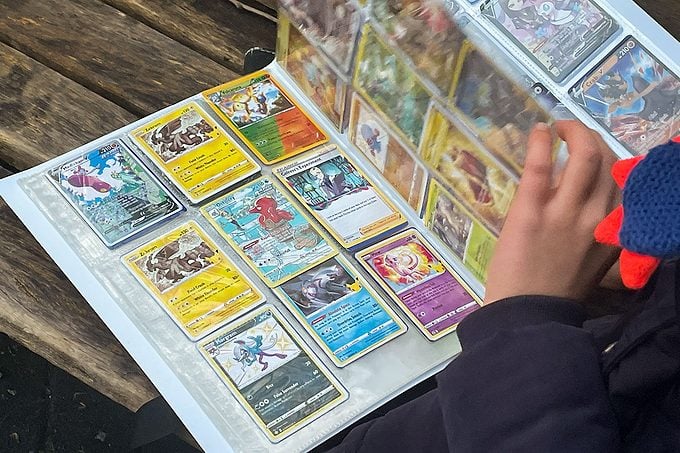
Somewhere in my basement, there’s a blue Trapper Keeper filled with approximately 400 (give or take 1,000) Pokémon cards, two crumpled pack wrappers and a perfectly preserved Fruit Roll-Up from 2007. My kids were obsessed with Pokémon once upon a time—those cards were a birthday and holiday staple for a solid decade. When they outgrew their obsession, the cards got zipped into the Trapper Keeper, and I forgot all about them.
Until I read that YouTuber Logan Paul sold a single Pokémon card for $16.5 million. Yes, million.
Maybe I should go check on that Trapper Keeper.
Everyone’s suddenly very interested in these quirky cards with names like Meowscarada, Igglybuff and Fidough. (I did not make up any of those names, I swear.) People are hunting down cards with the fervor of gold-rush prospectors, debating values with the intensity of Wall Street traders, and—I promise I’m not making this up either—arguing with actual charts that Pokémon cards are a better investment than the S&P 500. According to trading card valuation tool Card Ladder, Pokémon cards have appreciated more than 3,200% over the past 20 years, compared with about 483% for the S&P 500 over the same period. Also: $16.5 million. Just leaving that there.
So, are Pokémon cards actually a good investment? According to Stephen Fishler, a leading collectibles expert and the co-founder of ComicConnect, who has facilitated the sale of some very valuable Pokémon cards, it’s complicated. “It’s really about how popular a card is or how popular a character is,” he says. And popularity, unlike a company’s balance sheet, can be fickle. So before you start mentally converting that Trapper Keeper into a retirement portfolio, there’s a lot more to unpack.
Read on to find out what you need to know—and also see which items in your collection could earn you some fast cash.
Get Reader’s Digest’s Read Up newsletter for more trends, money, humor, cleaning, travel, tech and fun facts all week long.
Why is Pokémon having a moment right now?
 Cliff Hawkins/Getty Images
Pokémon—which just celebrated its 30th anniversary—never really went away, but it hit differently once people had time on their hands and money burning a hole in their pockets. During the pandemic, nostalgic Millennials who had grown up trading cards in the late ’90s suddenly found themselves with extra time, extra stimulus cash and a lot of feelings about their childhoods. The result? An explosion of interest in vintage cards that sent prices skyrocketing and left Target shelves bare.
Jesús Garcia, director of trading card games at Heritage Auctions, sees the forces driving it clearly. “It’s a combination of nostalgia, scarcity and a new generation discovering the hobby,” he says. “People who grew up in the ’90s are now in their 30s and 40s, with disposable income, and they’re chasing the same cards they had, or couldn’t afford, as kids. At the same time, kids today are continuing to fall in love with the franchise just as their parents did 30 years ago.”
Certified financial planner Jeff Judge, whose son was once obsessed with Pokémon, points to another major accelerant. “I think a lot of what we are seeing is influencer culture,” he says. “Not necessarily that they’re the only ones investing in Pokémon cards, but they are driving the trend.”
He has a point. Logan Paul wore a $5 million Pikachu card into a WWE ring. Ken Goldin, the auctioneer who facilitated the most famous Pokémon card sale in history and the star of Netflix’s King of Collectibles: The Goldin Touch, noted in a recent interview that “there are certain individuals trying to acquire the rarest, highest-grade cards and taking them off the market for as long as they can.” When collectors with massive platforms make massive bets, everyone else starts checking their shoeboxes.
The 30th anniversary has fanned the flames, with prices reportedly up more than 100% year over year. And the Millennial buyer pool shows no signs of losing interest.
How much are these cards selling for right now?
“Cards are selling across virtually every price range imaginable. You can find cards worth as little as $1, while others have sold for over $1 million,” Garcia says. “There’s truly an entry point for every type of collector.”
At your local card show or on eBay, common cards go for $5 to $40. A decent holographic card from a popular set might fetch a few hundred dollars. And then there is Logan Paul’s Pikachu Illustrator card, which sold in February 2026 for $16.5 million—setting a Guinness World Record for the most expensive trading card ever sold at auction. That’s not just the most expensive Pokémon card ever; it beat every baseball card, basketball card and football card in history.
For context: Paul originally bought the Pikachu Illustrator for $5.275 million in 2021 and still made more than $8 million in profit after auction fees. Which sounds like an incredible investment story—except that, as Fishler points out, the same card in a slightly lower grade (PSA 9 instead of PSA 10) recently sold for $2 million. Same card. Very different price. The condition and the specific grade can be the difference between a life-changing payday and a merely impressive one.
For most of us, the more relevant range is $50 to $500 for cards that are in good condition but not legendary, and up to six figures for true vintage grails. Fishler notes that the everyday market at shows hovers between $20 and $40 for most cards people encounter—possibly worth a little something, but not exactly a college fund.
It’s one thing to sell Pokémon cards, but why are people investing in them?
Pokémon cards, like coins or wine or vintage watches, have emerged as alternative assets—things people invest in outside of traditional stocks, bonds and real estate. What’s the appeal? Rare cards have an extremely limited supply (only 39 Pikachu Illustrators were ever made), they’re physical objects with nostalgic and cultural significance, and they’ve demonstrably appreciated in value over time.
Some investors treat them like a diversified portfolio. According to Card Ladder data, the average Pokémon card has appreciated nearly 46% in a single year—far outpacing the S&P 500’s average annual return of around 12%. Investors who bought a first-edition Shadowless Charizard for $5,000 in 2013 and sold it for $390,000 in late 2023 saw a return of more than 7,500%.
Judge explains the investment theory: Supply is fixed (Pokémon isn’t reprinting old cards), demand keeps growing (the nostalgic Millennial buyer pool isn’t getting smaller), and conditions matter enormously (a professionally graded, pristine card can be worth 10 to 100 times more than the same card in rough shape). Get the right card in the right grade, hold it long enough, and the math is definitely mathing.
“Who is to say stamps, coins, cars, art, etc., are good or bad investments?” Judge adds. “Those really aren’t that drastically different than something like Pokémon cards.”
Garcia agrees, with one important caveat: “I always tell people to buy what they love first and let appreciation be a bonus. While we’ve seen significant growth in the value of these cards, they are still collectibles at their core and should be treated that way.”
 Picture Alliance/Getty Images
Is this a solid investment plan?
For some people in some circumstances, sure. For most people? Proceed with extreme caution.
Fishler is unusually blunt about this for someone who works in the collectibles business. “Taking your money away from the stock market and plowing it into Pokémon is a very dangerous thing to do,” he says. His concern isn’t that the cards aren’t valuable—it’s that the market is opaque, volatile and easy to misread, and online success stories aren’t investment advice.
He says to think of it more like gambling than investing: Seeing someone put $4 in a Vegas machine and win $500,000 doesn’t mean you should move your 401(k) to the casino. The same logic applies to Pokémon.
Judge, who, as a certified financial planner, spends his days steering clients away from exactly this kind of thinking, is more measured but arrives at a similar place. “I wouldn’t personally invest my money there,” he says, “but I think it could be a solid investment, like other collectibles, if it is something you truly understand, are passionate about, and there is a secondary market and high demand for purchases.”
The market is also illiquid, meaning that unlike stocks, you can’t sell a Pokémon card in a millisecond at a known market price. Selling a high-value card takes time, expertise and the right buyer. You might also be competing against people who do this full-time and know things you don’t. And then there’s the question of expertise. Knowing which cards are valuable, in what grades, from which sets, requires serious study. There’s no Pokémon Bloomberg terminal or index fund.
If you have a solid financial foundation—emergency fund, retirement contributions, diversified investments—and you want to put some fun money into cards? Fishler is supportive. “If you think they’re fun, you have [the money] and you won’t lose any sleep over the fact that there was 15% or 20% less than you paid, then go ahead.” But he is emphatic that retirement savings, college funds and home equity have no business going near a booster box.
Is this another bubble waiting to burst?
Anyone who lived through the late ’90s knows how this story can go. Beanie Babies had people convinced they were sitting on fortunes, and some families even made genuinely heartbreaking financial decisions over stuffed animals that eventually became garage-sale fodder. Just a few years ago, NFTs turned digital jpeg files into speculative gold—until they didn’t. The dot-com bubble made millionaires and then unmade them. Fishler himself remembers a parent around 2000 who cashed out their son’s college savings to buy Beanie Babies—a story that did not have a happy ending.
Pokémon cards have actually already had their own version of this. After the first wave of popularity in the late ’90s, the market cooled dramatically in the early 2000s. Cards that had seemed priceless became … pretty normal cards. The current boom is built on top of that history, which gives some analysts confidence that this isn’t just hype; the franchise has sustained real cultural relevance for three decades. Nintendo has done an exceptional job maintaining the brand, and the buyer base keeps refreshing as new generations discover the franchise.
But, Fishler warns, “we don’t really know in 20 years where Pokémon is going to be. It probably will still be around, but … something else might come along and steal its thunder, and all of a sudden Pokémon is now losing audiences, eyeballs and attention.”
Which of your cards might be worth serious cash?
 IDA MARIE ODGAARD/Getty Images
Here’s what you actually came for. Before we get into the list, two things matter more than which card you have: condition and authenticity. A card that’s bent, scratched or creased is worth a fraction of the same card in pristine condition. (And there go my millionaire dreams; my kids literally battled with their Pokemon cards. I think some even have blood on them.) The highest values are almost always for cards graded PSA 10 (Gem Mint)—meaning essentially perfect. A PSA 10 can be worth anywhere from 10 to 100 times more than the same card in a lower grade.
Garcia advises looking for cards that are both first edition and holographic, as those tend to carry the most value. “I’ve worked with many people who have found their old binders from childhood, and more often than not, there’s something of value inside,” he says.
With that in mind, here are the cards worth checking your collection for—from the legendary to the more realistically attainable.
Pikachu Illustrator (PSA 10): The most expensive Pokémon card ever sold, at $16.5 million, in 2026. Only 39 were made, awarded to winners of a 1997–1998 Japanese illustration contest. You almost certainly don’t have one. But if you do, you’ll recognize it: It’s the only Pikachu card where Pikachu is holding a pen.
1st Edition Shadowless Charizard: The rarest Pokémon card most collectors actually dream about owning. The PSA 10 version sold for $550,000 at Heritage Auctions in December 2025. Look for the “1st Edition” stamp on the left side and the absence of a shadow around the card image. Even in lower grades, this card commands serious money.
1st Edition Blastoise Holo (Base Set, Shadowless): Another cornerstone of the hobby. A PSA 10 sold for around $88,000 in July 2025. Similar rules apply: Look for the first-edition stamp and shadowless printing.
Umbreon Gold Star (POP Series 5): One of the most desirable English-language cards outside the Base Set. A PSA 10 fetched around $48,500 in late 2025. You’d only have gotten this card by redeeming Pokémon league points, so it’s quite rare.
Shining Charizard (Neo Destiny, 1st Edition): The black Charizard with foil treatment. A PSA 10 sold for around $15,000. It was a 1-in-300 pack pull when it was released, which means very few exist in great condition.
Umbreon VMAX Alternate Art (Evolving Skies): A more modern card, nicknamed “Moonbreon” by collectors. It’s been rising steadily—from around $578 in 2023 to more than $1,200 in 2025—and it’s considered one of the best modern-era investments.
Base Set unlimited Charizard (the common one): If you have a Charizard that isn’t 1st Edition and isn’t shadowless, don’t panic—you still might have something. In Near Mint condition, an unlimited Base Set Charizard can fetch around $2,000. In rough shape, much less. Still, it’s worth checking.
One important note from Fishler: Just knowing you have “a 1999 Pokémon Charizard” isn’t enough information to know its value. You need to identify the specific set, printing version and condition before looking up values.
So now what? How do you make some money?
If you’ve dug out that old card collection and you want to know if you have a small fortune on your hands, here are the steps to take—without getting scammed.
Step 1: Figure out what you have.
Don’t just eyeball it and post it on Reddit. Instead, look up the specific card. Collectors swear by TCGPlayer for everyday cards—it’s the largest dedicated trading-card marketplace in North America and shows actual market prices from completed sales, not just what sellers are hoping to get. For graded cards, PSA (Professional Sports Authenticator) is the go-to. Card Ladder is excellent for tracking trends over time. eBay’s “Sold Items” filter is also reliable because it shows what buyers actually paid. Choose the site, then type in the exact card name, set and any version information.
Step 2: Protect the card immediately.
Before you do anything else, slide it into a card sleeve. Don’t put it in a plastic bag, don’t stack it loose with other cards, and for the love of Mewtwo, don’t let your kid fold it into a ninja star (learn from my mistake). Cheap penny sleeves are fine for basic protection.
Step 3: If it might be valuable, get it graded.
Fishler is clear on this: “If you think you have something valuable, send it to a grading service, and they will grade it and send it back to you in a holder.” The major grading services are PSA, which commands the highest resale values, and CGC (Certified Collectibles Group), which can be more cost-effective for bulk submissions. Grading costs range from about $15 to $25 per card for standard service, so it only makes sense for cards that are already worth at least $50 in raw condition.
Step 4: Don’t try to grade it yourself.
You will overestimate its value. Everyone does. Fishler says that almost every person who comes to him thinks their card is worth three times what it actually is.
Step 5: Sell through legitimate channels.
For mid-value cards (under $1,000), using the completed listings on eBay as a price guide is reasonable. For anything more significant, Garcia recommends going straight to a specialist. “It’s important to speak with someone who understands which cards have potential value and can help assess their condition, as condition plays a key role in determining overall value,” he says. Use established auction houses like Goldin, Heritage Auctions or PWCC, which have authentication processes and serious buyer pools. Avoid “I’ll give you cash right now” situations from strangers at shows unless you’ve done your research.
Step 6: Watch for fakes.
Counterfeit Pokémon cards have been coming out of China for years, Fishler warns, and they’re increasingly convincing. If someone is offering you a deal that seems too good to be true on a rare card, it probably is. Buy graded cards from reputable services and sellers with verified track records.
One final thought: Some of the most surprisingly valuable items are the ones you’d never think to check. So if you haven’t looked at those old cards in a while, now might be the time. So my immaculate Fruit Roll-Up is probably not worth anything. But that holographic Charizard? Maybe I do have something. Or you might end up like the Pokémon dad who held on to every card because his kid loved them—which, come to think of it, is a pretty great outcome regardless of the market price.
About the experts
Stephen Fishler is a leading collectibles expert and the co-founder of ComicConnect, one of the country’s premier auction houses specializing in comics, trading cards and pop culture memorabilia. He has been buying, selling and appraising rare collectibles for decades, and his firm has facilitated some of the most significant card and comic sales in history.
Jesús Garcia is the director of trading card games at Heritage Auctions, one of the world’s largest auction houses for collectibles and memorabilia.
Jeff Judge, CFP, is a managing partner and certified financial planner practitioner at Chesapeake Financial Planners in Bel Air, Maryland. He specializes in comprehensive financial planning, including investment strategy, estate planning and risk management. He is also a proud Pokémon Dad.
Why trust us
At Reader’s Digest, we’re committed to producing high-quality content by writers with expertise and experience in their field in consultation with relevant, qualified experts. We rely on reputable primary sources, including government and professional organizations and academic institutions as well as our writers’ personal experiences where appropriate. We verify all facts and data, back them with credible sourcing and revisit them over time to ensure they remain accurate and up to date. Read more about our team, our contributors and our editorial policies.
Sources:
Stephen Fishler, co-founder of ComicConnect; interviewed, April 15, 2026
Jeff Judge, CFP, managing partner at Chesapeake Financial Planners; interviewed, April 15, 2026
Jesús Garcia, director of trading card games at Heritage Auctions; interviewed, April 15, 2026
CNBC: “Logan Paul sold a Pokémon card for more than $16 million. Here’s why investors are watching”
CNN: “Logan Paul Pokémon card auction”