Konami’s Castlevania series has been on the back burner for a few years now with the most recent entry, Castlevania: Lords of Shadow 2, gracing consoles back in 2014. The game had an okay reception but never really broke into the collective consciousness, leading to nothing but pachinko. Remasters filled the drought in the 2020s.
These remasters were received well, giving Konami the proof they needed to fire up a new Castlevania, handing the development over to Evil Empire and Motion Twin. Cue Castlevania: Belmont’s Curse, a new 2D “Metroidvania” title that unites various series lore, along with the anime series, to create something rather special.

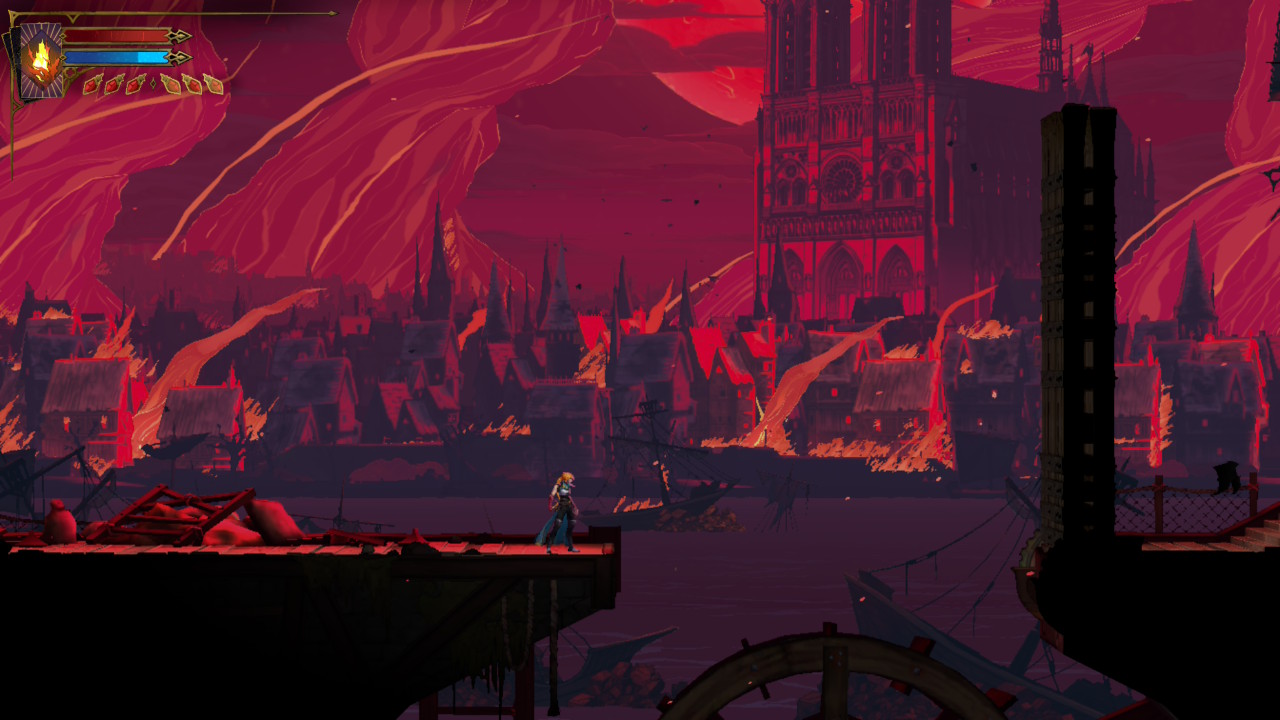
The story opens with Rose and Trevor Belmont arriving in a burning Paris, splitting up and going to deal with multiple problems. Before parting ways, Trevor hands Rose a deck of Tarot cards created by her mother, playing a huge role throughout the game. These cards allow Rose to grow in strength as the adventure goes on. The story is decently well paced overall, weaving together cutscenes and during the game through things like dialogue and environmental storytelling. Belmont’s Curse is also well voice acted giving characters a decent presence in the story even when not directly involved in a scene.
It’s hard to call this a return to form when it might be better than most other Castlevania titles since the DS games. The development team have clearly been looking at modern games in the genre and found some good solid focusses for the project. Movement was one of these. Traversal in Castlevania: Belmont’s Curse is great fun – after the first boss players will have expanded traversal abilities that add a lot of momentum to proceedings.

Players will run through rooms of enemies, sliding under them, countering attacks, grappling, swinging and wall jumping. It’s fluid, fast and engaging. As good as previous Castlevania titles are, they often had quite static exploration with the occasional traversal tool or ability coming relatively late. This is true even in PlayStation darling, Symphony of the Night. Obviously this takes some time to learn, but all moves the game gives the player to move are also usable in combat.
Fighting is also slick. Utilising the RPG elements of past games, players will get multiple types of weapons each with their own benefits and move-sets. Players are encouraged to experiment to find their favourite and to explore for some hidden additional weapons. Combat doesn’t rely on combos as such but there are light and heavy attack combinations. Instead it is all about positioning, reach and learning patterns. Nothing feels cooler than hopping over a boss’s devastating attack and landing a solid hit on it instead.

Level design is also pretty strong, featuring a sprawling map split into areas that players can visit as much as they want, reinforcing the “Metroidvania” mantra of using skills and items to explore previously completed areas for new paths and secrets. Each path has platforming challenges making sure players are kept on their toes. Sometimes these challenges are genuinely pretty hard so when the player opens a shortcut they’ll feel very satisfied.
Health is not so classic here, players get three or so heals at the beginning of the game that recharge with either enemy drops or by finding save rooms. Mismanaging health will result in a lot of deaths as the game is very hard at times. For players who are struggling, the game does have some assist modes allowing for greater accessibility and customising of the experience. A big one for frustrated players is being able to turn on boss door respawns which means a boss death just restarts the fight rather than forcing a weary player to redo the run to the boss room from the save point. For players with greater needs, they can also activate invulnerability if they just want to explore and see the story unhassled.
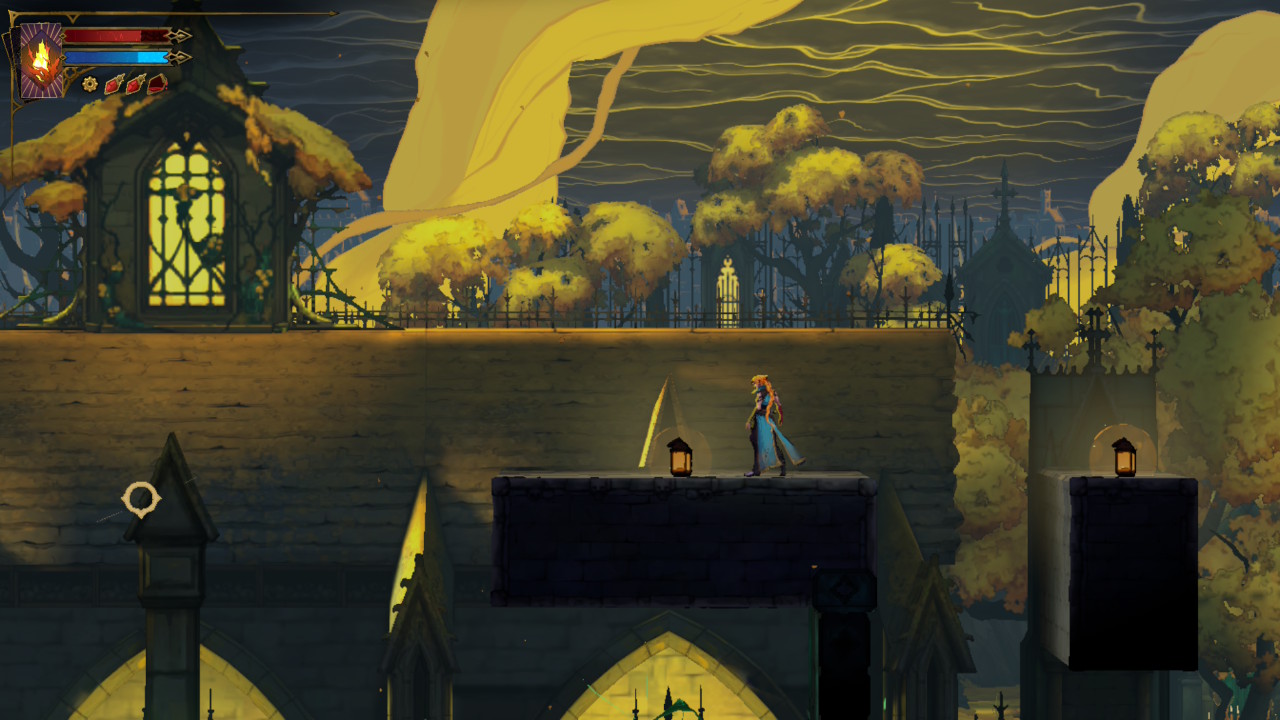
Visually, the devs have used 2.5D visuals with very strong colour scheming. Rose herself is blue with bright yellow hair making her stand out no matter the dark, muted or bright background as the game rarely uses a straight blue in its levels. Characters have this cool sharp comic book styling somewhat close to the Netflix Castlevania anime style. Each character has a portrait that displays during dialogue and while their in game models are not quite so sharp on switch, it’s a decent match-up. There is one issue on Switch, though, and that is that the game is limited to 30fps. Granted it hits this flawlessly, but for the more reaction based moments this can feel sluggish compared to the silky smooth 60fps of other consoles.
Levels have easy to read interactive elements that are stylised the same throughout the game. This keeps things readable at a glance so the game can focus on its chaining of obstacles without being unfair. In fact the game’s structure and visual design are pretty harmonious making the game feel frictionless and cohesive. Most levels rely on detailed backdrops full of movement and utilising subtle gradiented colours across background layers. It’s a busy style, but manages to feel lively without being distracting.
Sound sees similar excellence in both new and returning tracks. The composers, Daniel “ASADI” Asadi and Yoann Laulan, have a very specific style letting Belmont’s Curse carve its own space in the soundtrack space but feeling distinctly Castlevania at the same time. A particular highlight is the game’s version of Bloody Tears which utilises the melody of the classic track but benefits from deep bassy modern sounds and full orchestration that work in tandem. A quick note on sound effects as well – they are punchy and stand out against the other soundscapes, this is a boon to players who are moving quickly as they will know from these noises what they have collected, hit and interacted with without needing to wait for animations to play out.